Key Takeaways
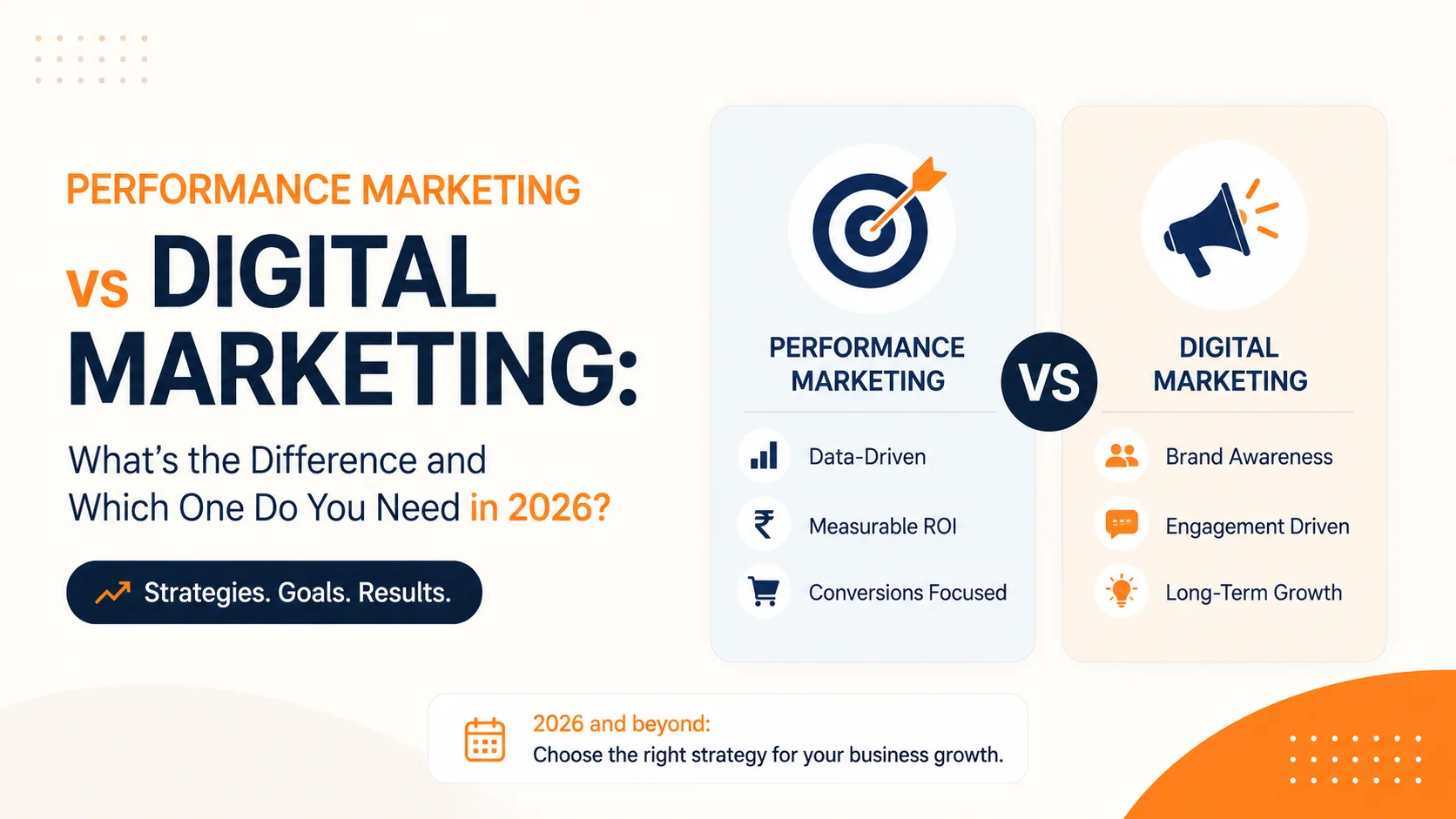
- Digital marketing is the entire umbrella of online marketing; performance marketing is a specific, ROI-focused subset.
- Performance marketing means you only pay when a measurable action is completed — a click, lead, or sale.
- Neither is "better" — they serve different timelines and goals. The best brands use both together.
- If you need revenue now, lean into performance marketing. If you're building for five years, invest in digital fundamentals.
Every business owner and marketer has been there. You sit across from an agency, and they throw around terms like "performance marketing," "digital marketing," "ROAS," and "brand awareness" — sometimes all in the same sentence. By the end of the meeting, you have a proposal in your hand and a headache forming behind your eyes.
Here's the truth: performance marketing and digital marketing are not the same thing. One is a broad universe. The other is a specific, results-driven strategy that lives inside that universe. Confusing the two can cost you lakhs of rupees in misallocated budget and months of wasted effort.
This guide breaks it all down — clearly, honestly, and without the jargon.
What Is Digital Marketing? (The Big Picture)
Digital marketing is the umbrella. It refers to every marketing activity that happens online — from posting on Instagram to running Google Ads, from writing blog articles (like this one) to sending email newsletters.
Think of digital marketing as the entire ocean. It includes:
- Search Engine Optimisation (SEO) — getting your website to rank on Google organically
- Content Marketing — blogs, videos, podcasts, infographics that attract and educate your audience
- Social Media Marketing — building a presence and community on platforms like Instagram, LinkedIn, and YouTube
- Email Marketing — nurturing leads and customers through their inbox
- Paid Advertising — running ads on Google, Meta, YouTube, and beyond
- Influencer Marketing — partnering with creators to reach their audiences
- Performance Marketing — a specific, ROI-driven subset of paid digital marketing (more on this below)
Digital marketing is both a long-term brand-building exercise and a short-term conversion tool, depending on how you use it. The results can be slow (SEO takes months) or fast (a paid ad campaign can generate leads within hours). Most importantly, not everything in digital marketing is directly tied to a measurable business outcome — and that's by design.
Good to Know
A blog post might educate 10,000 people this month without converting a single one. That's still valuable. Brand awareness, trust, and authority compound over time.
What Is Performance Marketing? (The Focused Weapon)
Performance marketing is a subset of digital marketing with one defining characteristic: you only pay when a specific, measurable action is completed.
That action could be:
- A click on your ad
- A lead form submission
- An app install
- A product purchase
- A sign-up for a free trial
In performance marketing, every rupee spent is tracked against a specific outcome. There is no "we hope this builds awareness." There is only: did this campaign deliver the result we paid for, or didn't it?
Common performance marketing channels include:
- Pay-Per-Click (PPC) Advertising — Google Search Ads, Bing Ads
- Paid Social Advertising — Meta Ads (Facebook + Instagram), LinkedIn Ads
- Affiliate Marketing — paying commissions to partners who drive actual sales
- Programmatic Advertising — automated, data-driven ad buying across networks
- Retargeting Campaigns — showing ads to people who already visited your site
The metrics that matter in performance marketing are brutally honest: CPA (Cost Per Acquisition), ROAS (Return on Ad Spend), CPC (Cost Per Click), CTR (Click-Through Rate), and Conversion Rate. If the numbers don't work, you stop, optimise, and try again.
Performance Marketing vs Digital Marketing: The Core Differences
Let's put this side by side so the distinction is crystal clear.
| Factor | Digital Marketing | Performance Marketing |
|---|---|---|
| Scope | Broad — covers all online marketing | Narrow — focused on paid, measurable campaigns |
| Payment Model | Varies (time-based, project-based, retainer) | Pay-for-performance (per click, lead, or sale) |
| Primary Goal | Brand awareness + conversions over time | Direct, measurable conversions |
| Timeframe | Short-term and long-term | Primarily short-to-medium term |
| Risk | Lower risk (organic methods cost time, not money) | Higher risk if poorly managed, but highly controllable |
| Measurement | Some channels are hard to attribute directly | Everything is tracked and attributable |
| Best For | Building lasting brand equity and authority | Scaling leads, sales, and revenue quickly |
| Examples | SEO, content, social media, email, branding | Google Ads, Meta Ads, affiliate marketing, retargeting |
The key insight: performance marketing trades long-term compounding for short-term certainty. Digital marketing as a whole plays both games.
A Real-World Example: The Same Business, Two Different Strategies
Imagine you run a D2C skincare brand based in Delhi called Glow Theory. You have a budget of ₹2 lakhs per month for marketing.
A pure digital marketing approach
- ₹60,000 on SEO and blog content (slow burn — results in 6–12 months)
- ₹40,000 on Instagram organic content and community management
- ₹30,000 on email marketing automation setup
- ₹70,000 on influencer collaborations for brand awareness
Results after month one: more followers, growing email list, zero direct revenue attribution. But you're building something real.
A pure performance marketing approach
- ₹1,00,000 on Meta Ads targeting women aged 22–35 interested in skincare
- ₹60,000 on Google Shopping Ads for purchase-intent searches
- ₹40,000 on retargeting ads for website visitors who didn't buy
Results after month one: 340 purchases tracked directly, ₹4.2 lakh in revenue, ROAS of 2.1x. Numbers you can take to the bank.
Neither approach is wrong. But they serve very different purposes and timelines. The smartest brands in India today use both — performance marketing to generate revenue now, digital marketing to build the brand that makes performance marketing cheaper over time.
Glow Theory above is a hypothetical example. For a real D2C account run this way — full-funnel, over a multi-year engagement — see the Protein Godam case study.
The Winning Play
This is called a full-funnel marketing strategy, and it's the difference between brands that grow for a year and brands that compound for a decade.
When Should You Choose Performance Marketing?
Performance marketing is the right focus when:
- You need results fast. You've just launched a product, raised funding, or hit a seasonal window (Diwali, IPL season, back-to-school). You cannot wait six months for SEO to kick in.
- Your CAC (Customer Acquisition Cost) economics work. If your product has a healthy margin and a customer lifetime value that justifies the cost of paid acquisition, performance marketing can scale beautifully.
- You want full control and transparency. Every rupee tracked. Every campaign tested. No faith-based spending.
- You're scaling a proven offer. Performance marketing amplifies what's already working. If your conversion rate is already decent organically, paid amplification can multiply results 5–10x.
- You're running e-commerce, lead generation, or app installs. These are the native use cases where performance marketing absolutely thrives.
When Should You Choose Broader Digital Marketing?
A broader digital marketing strategy makes more sense when:
- You're playing the long game. Building a brand that people trust, search for by name, and return to repeatedly — that's not a performance campaign. That's years of content, community, and consistency.
- Your product has a long sales cycle. B2B companies, high-ticket services, and complex products require nurturing. A CTO isn't going to click a LinkedIn ad and buy ₹50 lakh worth of software. They need blog content, webinars, case studies, and 12 touchpoints before they're ready to talk.
- You want organic, compounding returns. SEO and content are assets. A blog post written today can drive traffic for five years. A paid ad stops the moment you stop paying.
- You're in a highly competitive paid landscape. In some industries — insurance, real estate, fintech — the CPCs on Google are astronomical. In these spaces, building organic authority is not just smart; it's survival.
- You're building brand equity. Investors, partners, and premium customers look for brands they recognise and trust. That trust is built through digital marketing, not performance campaigns.
Common Mistake to Avoid
Treating performance marketing and digital marketing as competitors. They are not. They are partners. The brands that win in 2026 are running integrated strategies.
The Biggest Mistake Marketers Make
Here it is, plainly: treating performance marketing and digital marketing as competitors.
They are not. They are partners.
The brands that win in 2026 are running integrated strategies — using content and SEO to lower their cost of acquisition over time while simultaneously running performance campaigns to hit revenue targets today. Their influencer marketing builds brand awareness that makes their retargeting ads more effective. Their SEO rankings mean people are already searching for them before they see an ad.
This is called a full-funnel marketing strategy, and it's the difference between brands that grow for a year and brands that compound for a decade.
Performance Marketing in India: What You Need to Know
The Indian digital advertising market crossed ₹40,000 crore in 2025 and continues to grow at 15–20% annually. But the landscape here has unique characteristics that every marketer needs to understand:
- Regional nuance matters. India is not one market. A Meta Ads campaign that works in Mumbai may completely fall flat in Tier 2 cities if the creative, language, and messaging aren't adapted.
- Mobile-first is non-negotiable. Over 85% of digital ad consumption in India happens on mobile. If your landing pages aren't lightning-fast on a mid-range Android phone on a 4G connection, your performance marketing budget is leaking.
- WhatsApp is an underutilised performance channel. Click-to-WhatsApp ads on Meta are one of the highest-converting ad formats in India right now, especially for local businesses and high-touch sales processes.
- The rise of AI in ad platforms is accelerating. Meta's Advantage+ and Google's Performance Max campaigns are now heavily AI-driven. Understanding how to feed these systems the right signals — good creative, clean conversion data, proper audience seeds — is a core performance marketing skill in 2026.
How to Get Started: A Practical Framework
Whether you're starting from zero or reassessing your current mix, here's a simple framework:
- Define your goal clearly. Are you trying to generate leads, drive e-commerce sales, build brand awareness, or all three? Your goal determines your channel mix.
- Understand your economics. Calculate your average order value, profit margin, and the maximum you can afford to pay per customer. This becomes your target CPA and guides your performance marketing bids.
- Start with one performance channel. Don't try to master Google Ads, Meta Ads, and affiliate marketing simultaneously. Pick the channel where your audience is most active and go deep.
- Build your content foundation in parallel. Even if you're primarily a performance marketer, invest in SEO and content consistently. It reduces your dependence on paid channels over time.
- Measure everything. Set up Google Analytics 4, Meta Pixel, and conversion tracking before you spend a single rupee on ads. You cannot optimise what you cannot measure.
- Test, learn, and scale. Start with a small budget. Test different creatives, audiences, and landing pages. Find what works. Then scale it.
Calculate Your Influencer Engagement Rate Instantly
Know exactly what you're paying for before you sign any influencer deal. Our free calculator gives you engagement benchmarks, estimated reach, and fair pricing in under 30 seconds.